

Research, Design and Launch CentralValuations.ie
Central Valuations | Nationwide Residential Valuations Platform
Position: Product and UX Leader
Role in Project: Founding Designer
Scope: Product vision, system architecture, UX, delivery leadership
Team: Distributed engineering team, industry partner (commercial)
Ownership: End-to-end product strategy, platform design, regulatory model, execution
TL;DR
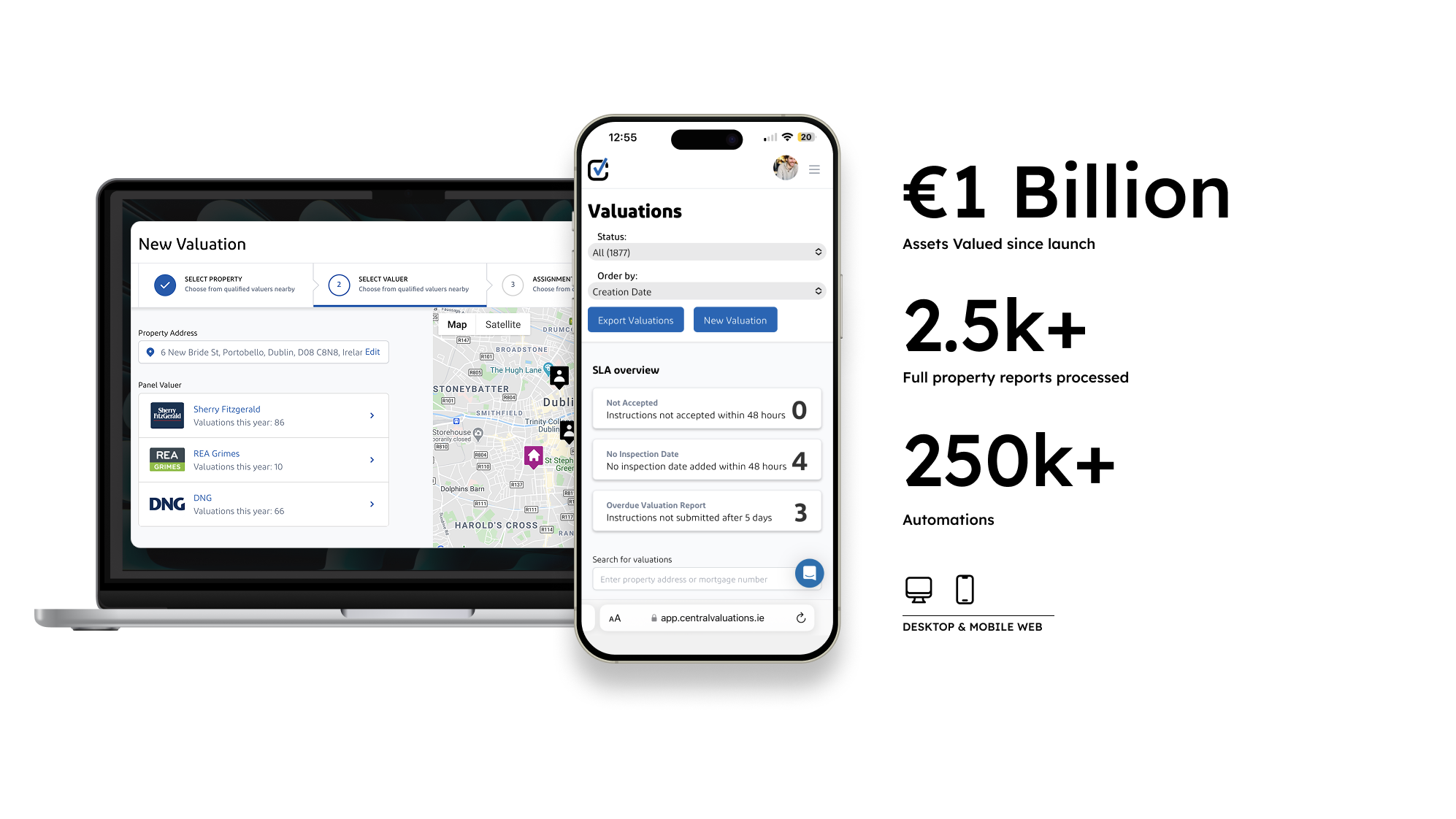
I led the zero-to-one design and launch of CentralValuations.ie, Ireland's first centralized, paperless residential valuations platform, built as neutral infrastructure in a highly regulated mortgage-lending environment. Designed for trust, auditability, and scale rather than speed, the platform replaced fragmented manual workflows with a secure system of record connecting lenders and certified valuers nationwide. Since launch it has supported €1bn+ in property assets, processed 2,500+ valuations, onboarded 245 valuers, and reduced valuation turnaround time from ~15 days to under 11 days. The core success factor was designing for regulation and lender risk from day one, treating auditability as non-negotiable, and building infrastructure that scaled without redesign.
1. Context
Residential property valuation in Ireland underpins regulated mortgage lending, yet until recently the process remained largely manual:
- Handwritten notes taken on site
- Photos captured separately
- Wet-ink signatures
- PDFs scanned, compressed, and emailed
- No shared system of record
- No auditable change history
Despite the regulatory importance, the industry relied on email chains and individual file storage.
Central Valuations was created to address this structural gap: a single, trusted system connecting lenders and certified valuers nationwide with transparency, auditability, and regulatory integrity built in.
2. The Problem
The core problem was not digitisation. It was trust, accountability, and coordination. Lenders needed confidence in valuation accuracy, verifiable digital signatures, complete audit trails, and faster turnaround without regulatory risk. Valuers needed mobile-first, on-site workflows, no duplication of effort, reduced administrative burden, and clear instructions and status visibility. Any solution that prioritised speed over trust would fail. Regulation does not tolerate ambiguity.
3. Constraints
- Highly regulated mortgage lending environment
- Multiple actors with conflicting incentives
- Zero tolerance for data ambiguity or loss
- No existing shared industry infrastructure
- Required adoption by lenders before valuers
These constraints ruled out marketplace models or lightweight tooling. This had to be infrastructure.
4. Strategy and Vision
The strategic decision was to design Central Valuations as neutral infrastructure, not a marketplace or intermediary.
The platform would:
- Act as the system of record
- Enforce consistency without dictating valuation judgment
- Make the full lifecycle observable and auditable
- Scale nationally without redesign
Trust, not speed, was the primary design constraint.
5. Key Decisions
Infrastructure over marketplace
Rejected a two-sided marketplace model in favour of a neutral system of record trusted by lenders.
Auditability as a first-class feature
Designed full change histories, time-stamped logs, and exportable audit trails from day one.
Role-based multi-tenant architecture
Built strict data isolation and permissions across lenders, brokers, valuers, and firms.
Mobile-first completion, not post-visit admin
Optimised workflows for completion on-site at the property, eliminating follow-up work.
These decisions traded short-term speed for long-term credibility and scale.
6. Platform Architecture and Experience Design
I designed the platform from the ground up as a secure, multi-tenant system supporting:
- Lenders (admins and users)
- Brokers
- Individual valuers
- Valuer firms and administrators
Key system components included:
Digital Valuation Workflow
Structured valuation forms editable on desktop, tablet, or mobile, designed for on-site completion.
Integrated Media and Documents
Direct photo capture, automated resizing and compression, and secure document delivery via lightweight links.
Custom Core Infrastructure
Bespoke authentication and authorization, native digital signing compliant with lender requirements, and end-to-end document lifecycle management.
Auditability by Design
Persistent valuation history, full change tracking on prices and access, and time-stamped, exportable audit logs.
Nothing in the system was implicit. Everything was provable.
7. Delivery Model
The platform launched with live lenders and certified valuers from day one. In the early phase, I personally designed critical flows required to close initial lender partnerships, adjusted UX and system logic directly to unblock sales, and worked hands-on with engineers to ship production features rapidly.
Once the platform reached operational stability and scale, I transitioned to a lighter advisory role. Ongoing execution moved to my co-founder, supported by a distributed engineering team. The original architecture remains intact, validating the upfront system design and domain research.
8. Outcomes
As of today, Central Valuations has achieved:
- 245 certified valuers nationwide
- 227 valuation offices on the platform
- 2,500+ completed full valuations
- 250,000+ automated system events
- €1bn+ in property assets valued
- Instruction-to-completion reduced to under 11 days
Manual coordination was replaced with traceable system events, dramatically reducing phone calls, emails, and error-prone handoffs.
9. What Worked
- Deep domain research with valuers before writing code
- Designing for regulation, not convenience
- Treating auditability as non-negotiable
- Building infrastructure that scaled without redesign
Critically, the platform acknowledged reality: valuers are users, but lenders bear the risk. Accuracy, traceability, and signatures mattered more than speed alone.
10. Limitations and Future Opportunities
There are clear opportunities to accelerate workflows using AI, particularly around data aggregation and report preparation.
However, valuation judgment cannot be automated away. Lender confidence, not technical capability, is the binding constraint.
The platform was deliberately designed to allow future augmentation without compromising trust.
11. Reflection
Central Valuations was my first opportunity to lead a true zero-to-one initiative in a regulated environment. The core lesson was that durable products in regulated systems are won before the first line of code: through domain understanding, architectural restraint, and clarity about who ultimately bears risk. That discipline is why the system still holds up today.